> For the complete documentation index, see [llms.txt](https://docs.finops.softwareone.com/llms.txt). Markdown versions of documentation pages are available by appending `.md` to page URLs; this page is available as [Markdown](https://docs.finops.softwareone.com/insights/recommendations/recommendation-categories/security-recommendations.md).
# Security recommendations
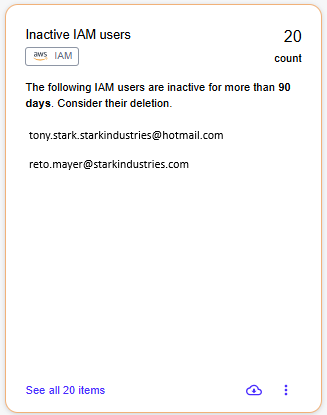
### Inactive IAM users
Users who have been inactive for more than **90 days** are considered obsolete and subject to deletion. This is due to the security risks they pose for the organization, as they can be compromised and become access points for malicious users.
The number of days is a custom parameter. Use **Settings** to change it. You can also download a list of inactive users as JSON or XLSX by selecting the download icon .
Inactive IAM users
### Instances with insecure Security Groups settings
Security check that browses through the resources to find network vulnerabilities and provides a list of instances liable to RDP/SSH hacking. The following are the insecure ports and permissions:
* port tcp/22
* port tcp/3389
* all inbound traffic
with one of:
* CidrIp: 0.0.0.0/0
* CidrIpv6: ::/0
**AWS**
* Describe regions: *ec2.describe\_regions()*
* Describe instances: *ec2.describe\_instances()*
* Describe security groups: *ec2.describe\_security\_groups()*
**Azure**
* Describe instances: *compute.virtual\_machines.list\_all()*
* Describe security groups: *network.network\_security\_groups.list\_all()*
{% hint style="info" %}
Network interfaces without associated security groups are skipped.
{% endhint %}
You can download the list of insecure Security Groups as JSON for subsequent automated processing.
### IAM users with unused console access
The active IAM users that have console access turned on, but have not used it for more than **90 days** are in the list. Consider revoking console access to increase security.
Note that the number of days is a custom parameter. Use **Settings** to change it.
### Public S3 buckets
The S3 buckets in the list are public. Ensure that the buckets use the correct policies and are not publicly accessible unless explicitly required.
---
# Agent Instructions
This documentation is published with GitBook. GitBook is the documentation platform designed so that both humans and AI agents can read, navigate, and reason over technical content effectively. Learn more at gitbook.com.
## Querying This Documentation
If you need additional information that is not directly available in this page, you can query the documentation by asking a question.
Perform an HTTP GET request on the following URL with the `ask` and `goal` query parameters:
```
GET https://docs.finops.softwareone.com/insights/recommendations/recommendation-categories/security-recommendations.md?ask=&goal=
```
`ask` is the immediate question: it should be specific, self-contained, and written in natural language.
`goal` is what the user is ultimately trying to achieve, the reason they need the answer. Sharing it helps GitBook give you a better, more relevant answer. A goal is most helpful when it describes the outcome the user wants rather than restating the question. For example, with `ask=how do I create an API token`, a goal like `automate deployments from our CI pipeline` lets GitBook tailor the answer to that use case.
The response will contain a direct answer to the question and relevant excerpts and sources from the documentation.
Use this mechanism when the answer is not explicitly present in the current page, you need clarification or additional context, or you want to retrieve related documentation sections.
 .
.